AI, cybersecurity, and strategy: why alignment matters more than speed
Every business owner I speak with is hearing the same drumbeat right now.
AI is moving fast. Competitors are experimenting. Vendors are promising efficiency, leverage, and growth.
And almost without exception, the conversation starts with tools.
That is exactly where the risk begins.
AI is not a strategy. Cybersecurity is not a strategy. They are powerful tools that can either strengthen a business or quietly increase its fragility, depending entirely on how and when they are applied.
Over the years, I have seen this pattern repeat itself with new technologies. What changes is the speed and scale. AI accelerates both value creation and risk at the same time. When deployed without clarity, AI does not just fail to deliver returns, it can overwhelm systems, expose vulnerabilities, and distract leadership from what actually drives sustainable growth.
The missing question is not “what can AI do?”
The missing question is “what are we trying to accomplish, and are we ready to support it?”
Strategy first, always
Before any meaningful investment in AI or automation, a company needs clarity around a few fundamentals. Where are we strong today? Where are we exposed? What systems are stable, and which ones are already stretched? What does success actually look like three years from now?
Most businesses that appear successful on the surface carry a quiet concern underneath. Will this last? Are we; one bad hire, one cyber incident, one operational failure away from trouble? That sense of fragility is not irrational. It is often well founded.
AI layered onto an unstable foundation does not fix the instability. It amplifies it.
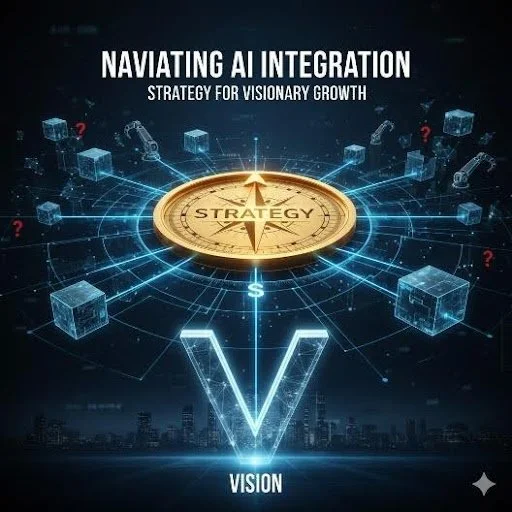
This is why strategy and vision must lead the conversation. AI should serve the business’s direction, not pull it in a new one. When technology starts dictating behavior instead of enabling it, the business slowly drifts away from its core strengths.
Cybersecurity is not an optional guardrail
One of the most underestimated risks in the current AI rush is security. Many AI solutions are being deployed by people who are brilliant at automation but lack deep experience in infrastructure, data protection, and threat mitigation.
AI systems touch data. They make decisions. They automate communication. They create new attack surfaces whether leadership intends that or not.
Treating cybersecurity as an add-on, or something to “circle back to later,” is no longer viable. In practical terms, that would be like installing a high-performance engine in a car without upgrading the brakes.
Security and reliability are not constraints on innovation. They are what make innovation survivable.
The sequencing matters
There is a concept I return to often with owners: sequencing. Not everything that adds value should be done immediately, even if it can be done immediately.
A business without predictable cash flow, operational discipline, and decision clarity can easily be overwhelmed by growth that arrives faster than it can support. AI-driven efficiency can create demand spikes, complexity, and exposure that the organization is not prepared to manage.
That does not mean waiting forever. It means understanding timing.
In the right sequence, AI becomes a lever. It frees leadership time, improves decision quality, reduces cost, and creates durable advantage. In the wrong sequence, it becomes noise, distraction, or worse, a liability.
AI as part of the strategic system
When AI and cybersecurity are aligned with strategy and vision, something powerful happens. They stop being “initiatives” and start becoming part of the operating system of the business.
AI supports the way the company thinks, decides, and executes.
Cybersecurity protects not just systems, but trust, reputation, and continuity.
Strategy ensures both are pulling in the same direction.
That alignment is what separates short-term experimentation from long-term advantage.
The companies that will win with AI are not the ones moving the fastest. The winners will be those moving deliberately, with clarity, guardrails, and intent.
And in my experience, that starts not with a tool, but with a conversation.
By John P. Foster MBA, CBEC, and Brett Shadrick