For decades, leadership experts have repeated a simple truth: business is a team sport. Organizations succeed not because individuals produce brilliant work in isolation, but because groups of people learn to integrate ideas, challenge one another, and ultimately align around a decision.
Yet something subtle is changing.
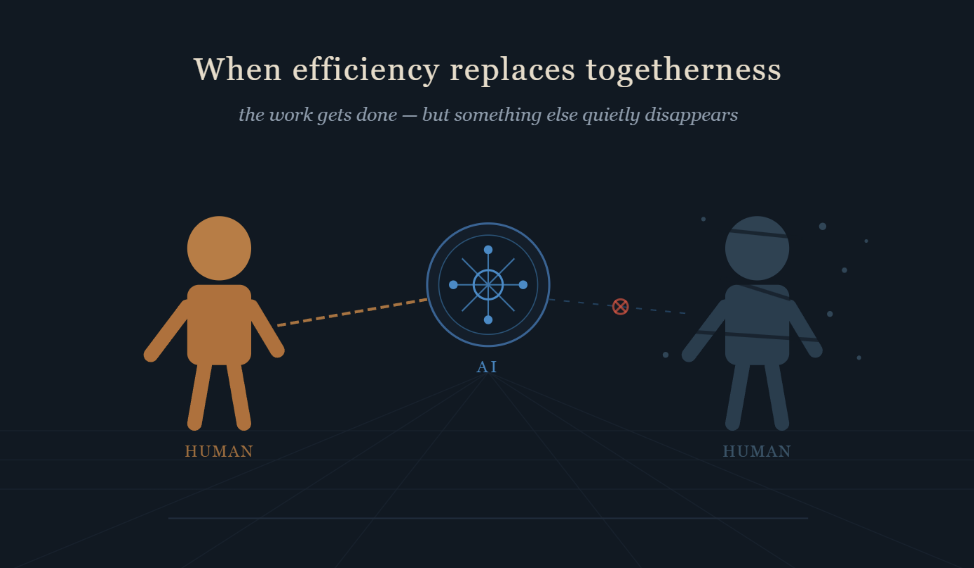
A recent Wall Street Journal article by Duke University professor Scott Dyreng described a surprising experiment in his MBA classroom. When he allowed students to use artificial intelligence on team assignments, the quality of the work did not collapse. In fact, assignments were completed efficiently. But something else deteriorated. The teams themselves began to unravel. More than half of the groups ultimately chose to break apart and complete their final projects independently. Students increasingly relied on AI to perform shared thinking rather than working through ideas together .
What disappeared was not productivity. It was the human work of collaboration; the debate, the negotiation, the process of building shared understanding.
As Dyreng observed, “if AI becomes the default study partner, collaboration begins to feel optional” .
This insight arrives at a moment when many organizations are already struggling with the lingering effects of the post-Covid workplace. Remote and hybrid work models have permanently altered how teams interact. For many companies, the informal moments that once built trust and alignment have been reduced or eliminated.
In the past, collaboration happened in hallways, during spontaneous whiteboard sessions, or in the small conversations before and after meetings. Those moments were not distractions. They were the connective tissue of organizational culture.
Today much of that interaction has been replaced by scheduled video calls, asynchronous communication, and digital task management systems. Teams divide the work, complete their portions independently, and merge the results later. AI now accelerates this pattern by making it even easier to generate content, summarize ideas, and produce finished outputs without requiring sustained human interaction.
From a productivity standpoint, the model appears efficient.
From a leadership standpoint, it raises important questions.
The most valuable leadership skill has never been writing the best memo or generating the fastest analysis. It is the ability to align a room full of capable people who do not naturally agree. As Nvidia CEO Jensen Huang recently observed; “the future will belong to people who can read the room, infer what is not said, and anticipate problems before they surface”.
Those are deeply human skills that are developed through interaction, not automation.
The risk facing organizations today is not that AI will replace human work. It is that it will quietly reduce the number of situations in which people must practice working together.
High output teams can still exist
Sure they can exist but they may become low cohesion teams.
The long-term consequences of that shift are significant. Trust forms more slowly. Conflict is avoided rather than resolved (see: Lencioni’s 5 Dysfunctions of a Team). Decision ownership becomes diffuse. Leaders may discover that although tasks are completed efficiently, alignment across the organization becomes fragile.
Fortunately, the same technology that exposes this problem may also help address it.
In Dyreng’s revised approach, students now record their team meetings and use AI tools to analyze the interaction itself. Technology does not evaluate the written assignment. Instead, it evaluates how the team works together. Did one person dominate the discussion? Did members interrupt one another? Were real alternatives debated, or did the group settle quickly into polite agreement?
The result is feedback on collaboration, not just output.
This shift changes the incentives. When teams know that the quality of their interaction will be evaluated, the rational strategy is no longer to divide the work and disappear. It is to engage more deeply with one another.
In other words, AI becomes a mirror rather than a substitute.
Organizations are beginning to experiment with similar approaches. Some leadership development programs now analyze meeting dynamics to improve facilitation skills (not unlike the EOS Level 10 format). Others focus on structured decision processes that force teams to articulate assumptions, debate alternatives, and assign clear ownership.
Experiential training environments are also gaining renewed attention. When teams must solve problems together in real time, whether in simulations, strategy exercises, or physical team challenges, the human mechanics of collaboration become visible again.
This is an important moment for leaders
The question is no longer whether AI will become part of daily work. It already has. The real question is how leaders design environments where technology amplifies human capability rather than replacing the interactions that build strong teams.
If collaboration quietly becomes optional, organizations may find themselves with impressive tools but weaker cultures. As I have written before; where culture can be a competitive advantage, this is a material chink in one’s armor.
The leaders who thrive in this next era will not simply deploy AI effectively.
They will design organizations where the technology strengthens what remains uniquely human: trust, shared judgment, and the ability to think together.
But here is the harder question worth sitting with: if your team could produce the same output tomorrow with half the human interaction — would you notice what was missing? And by the time you did, would it already be too late to get it back?