Most business owners assume that serious failure begins with a dramatic event.
A lost lawsuit.
A failed acquisition.
A sudden market collapse.
A key customer walking away.
But in many companies, decline begins much earlier. It starts quietly, with complexity, overconfidence, weak financial discipline, stale assumptions, and relationships that are treated as permanent until they are not.
That is what makes the recent turmoil surrounding Republic National Distributing Company worth paying attention to, even for business owners whose companies are a fraction of its size.
RNDC is one of the largest wine and spirits distributors in the country. Yet the company has faced a series of highly visible setbacks: the loss of major supplier relationships, its withdrawal from California, thousands of layoffs, and reports of potential market sales. The business press has described these events as remarkable because alcohol distribution has historically been viewed as a protected, durable business model.
For smaller companies, the lesson is not about alcohol distribution. It is about hidden risk.
A smaller business may not have supplier contracts worth hundreds of millions of dollars. But it may depend on one large customer, one rainmaker, one lender, one vendor, one location, one general manager, or one aging owner whose judgment and relationships hold the whole enterprise together.
That concentration may feel efficient while things are going well. It may even feel like strength. But concentration is not strength unless it is deliberately managed.
One of the comments in Monika Elling’s post is especially relevant to owners of smaller companies: “Volume hid the messiness.” That phrase captures a danger many owners recognize. When revenue is strong, problems are easier to ignore. Poor margins, weak accountability, messy incentives, thin management depth, customer concentration, and unreliable reporting can all be masked by top-line activity…until they cannot.
The smaller the company, the less room there is for denial. A large company may absorb a bad acquisition, a lost supplier, or a legal dispute. A smaller company may not survive the loss of its top customer, a credit tightening, a failed handoff to the next generation, or the departure of a key employee who carries the customer relationships in his or her head.
This is why business owners should periodically ask a hard question:
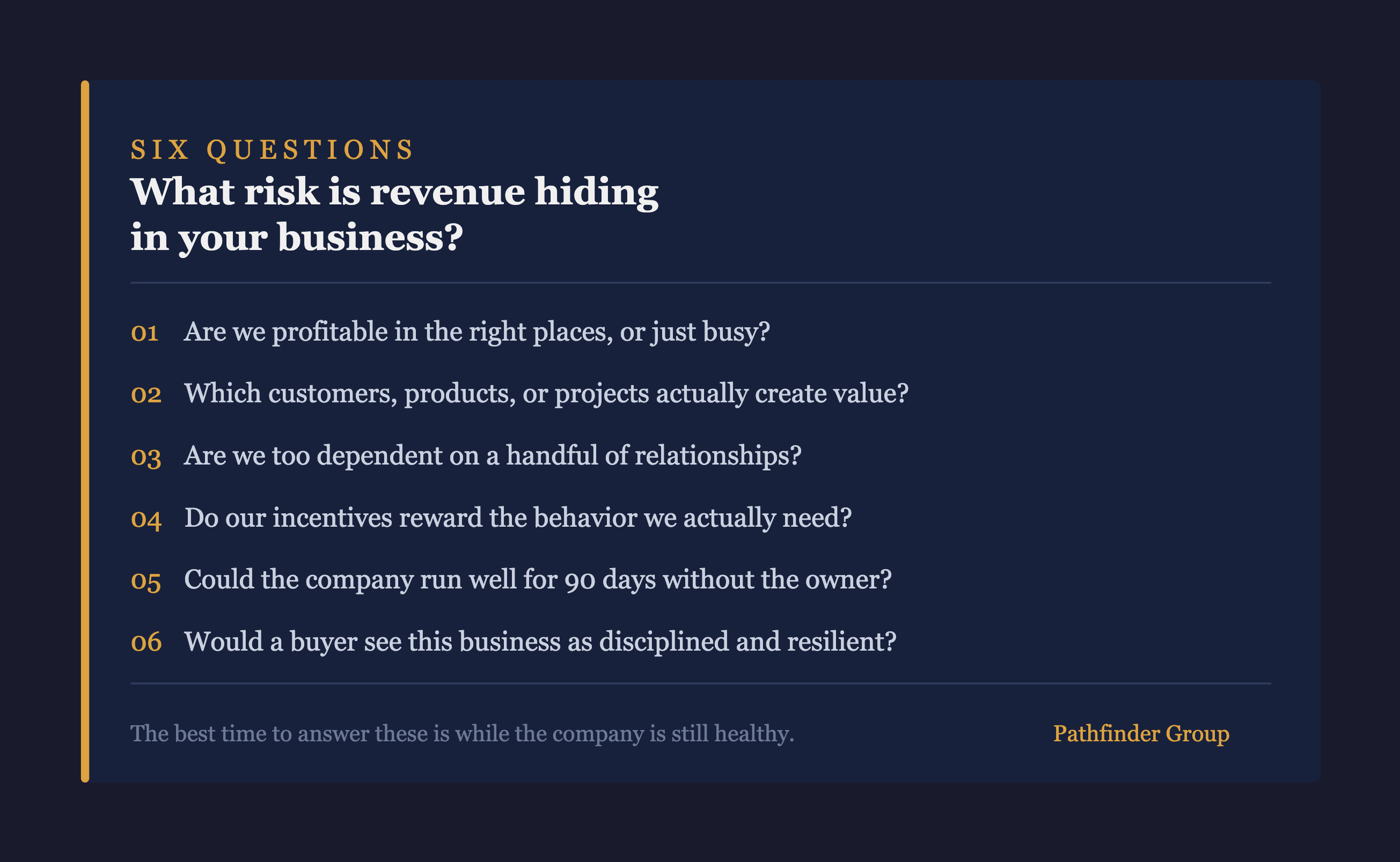
What risk in my company is currently being hidden by revenue?
That question leads to several others:
Are we profitable in the right places, or are we simply busy?
Do we know which customers, products, services, or projects actually create value?
Are we too dependent on a handful of relationships?
Do our incentives reward the behavior we actually need?
Could the company run well for 90 days without the owner?
Would a buyer, lender, or successor see our business as disciplined, transferable, and resilient?
These are not academic questions. They directly affect enterprise value.
A business that is overly dependent on the owner, a few customers, or informal processes will usually be valued differently than one with clean financials, management depth, repeatable systems, diversified revenue, and strong operating discipline.
Owners often think about value only when they are preparing to sell. That is too late! By then, the buyer sees the risks before the seller has had time to fix them.
The better approach is to build value long before a transaction is on the horizon. That begins by identifying the hidden risks that make the business fragile.
In RNDC’s case, the story is large, public, and industry-specific. But the warning applies broadly. No business model is so protected that it can ignore discipline. No relationship is so permanent that it can be taken for granted. No amount of volume can permanently hide weak execution.
For smaller companies, the takeaway is simple. Do not wait for a crisis to discover where your business is vulnerable.
The best time to assess concentration risk, management depth, financial discipline, and transferability is while the company is still healthy. That is when owners have options. That is when problems can be fixed. That is when value can be protected, and increased.
If you own or lead a privately held business and want to understand where hidden risk may be limiting value, Pathfinder Group can help you assess the business through the eyes of a buyer, lender, or successor. Don’t kick the can down the road. The best time to find your vulnerabilities is before they find you.
Let’s talk about where your business is today, where you want it to go, and what it will take to build greater value and flexibility. Schedule a conversation with Pathfinder Group.
https://calendar.app.google/oJpsr9gc6jBYzhZd6